
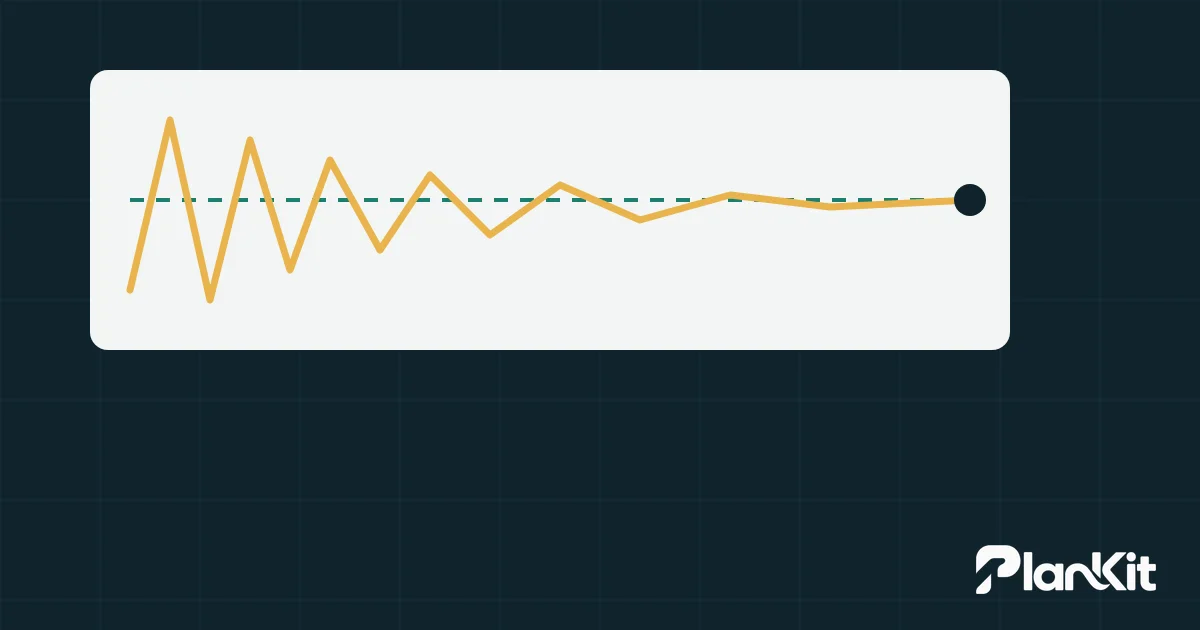
Paid ad results in the first month usually move through four stages. In week one you confirm that tracking and leads work while the platform learns. Weeks two and three are for testing ads and audiences and cutting clear losers. In week four you read your cost per result and decide whether to raise the budget. Early numbers are noisy by nature, and cost per result is usually higher at the start than where it settles.
Nobody can tell you which week your campaign will settle, because that depends on how many results it collects, and that depends on your budget, the result you ask for and the price of what you sell. What you control is what you watch each week, what you leave alone, and how you tell normal noise from a real fault. This article covers those, based on the official help pages of Meta, Google and TikTok as we read them on 26 November 2026. Those pages change.
Why paid ad results swing in the first days
Results swing early because every platform goes through a learning phase, a period in which it tries different people, times and placements for your ad. Meta's page on the learning phase says ad sets are less stable during it and usually have a higher cost per acquisition, and that results in this period are not necessarily indicative of future performance.
Each platform has its own rule, so a number from one does not carry over to another:
| Platform | When performance settles, per the platform | What restarts learning |
|---|---|---|
| Meta | An ad set exits learning once it delivers stably, which usually happens after about 50 results in the week after its last significant edit | Significant edits, listed further down |
| Google Ads | The "Learning" bid strategy status never lasts more than 7 days, and the system takes one or two conversion cycles to converge on a new goal, according to the bid strategy status page | A new strategy, a change to its composition, or a change of conversion goal |
| TikTok | Volatility typically starts to decline after about 25 results or 7 days from entering learning, according to TikTok's learning phase page | TikTok advises against pausing campaigns or ad groups, edits that retrigger learning, and unreasonable budgets |
A conversion cycle is the usual time between a customer's click and their conversion, meaning the lead or the purchase. If your customers take ten days to decide, two cycles means twenty days before a Google bid strategy can be judged fairly.
The second reason is small numbers. A hypothetical example: a campaign brings four leads on Sunday and one on Monday. That looks like a collapse, yet it is three leads that could come or go by chance. Meta's guide to performance fluctuations advises reading results for the whole campaign or ad set over a full week, and warns that hourly breakdowns show swings that average out over time.
The third reason is conversion delay. Google's page on evaluating bid strategies notes that recent performance can look weaker because of it: some people who clicked this week will buy next week and be counted then. Yesterday deserves less weight than a week that has fully closed.
The first month week by week in one table
The table sums up the month, and the sections after it explain each row. The timings are approximate and stretch with your budget, since an account that collects few results needs longer at every stage.
| Week | Goal | What to watch | What to leave alone |
|---|---|---|---|
| 1 | Confirm everything works | Ad status, daily spend, leads reaching your team, and whether their count matches the platform | Targeting, creatives and the optimisation event |
| 2 | Collect enough results to compare | Results per ad set, cost per result over 7 days, and sales feedback on lead quality | Judging an ad on one or two days |
| 3 | Cut clear losers and add one new test | Ads past your loss limit, Learning limited and creative fatigue statuses | More than one round of significant edits a week |
| 4 | Decide to scale, adjust or stop | Cost per result against what you can afford, and how many leads became sales | Doubling the budget in one jump |
Week one: check the tracking and let the platform learn
Your job in week one is to confirm that what the platform shows is real. Judging performance comes later. The pre-launch checks and what to watch on launch day are in our checklist before launching your first ad campaign, so they are not repeated here. After launch, a short daily check in four steps is enough:
- Compare the number of leads in the platform with the number your team received. A large gap in either direction points to a tracking fault or a broken lead path.
- Open three random leads and check the details, or call them. Missing digits and nonsense names tell you about audience quality well before cost per result does.
- Look at daily spend. Meta says on the same page that it is gradually giving some accounts budget flexibility that allows spending up to 75% over the daily budget on some days, while weekly spend stays within seven times the daily budget. A day above budget is no fault in itself.
- Keep one file with every change you make and its date. When the numbers move two weeks later, you will know which change came first.
Hold your edits until the ad set leaves learning, unless you find a fault. Meta says editing an ad, ad set or campaign during learning resets it and delays the system's ability to optimise, and recommends editing only when you have reason to believe the change will improve performance.
What sends a campaign back into the learning phase
On Meta only a significant edit restarts learning, and its page on significant edits lists the changes that always count:
- Any change to targeting.
- Any change to the ad creative.
- Changing the optimisation event, which is the result you ask the platform to get.
- Adding a new ad to the ad set.
- Pausing the ad set for seven days or longer. It re-enters learning when you switch it back on.
- Changing the bid strategy.
Some changes may or may not count, depending on their size: the budget, the ad set spending limit, and a cost per result or ROAS goal. Meta's own example is that raising a budget from 100 to 101 is unlikely to restart learning, while going from 100 to 1,000 may.
Google Ads works differently. Learning appears after the structural changes in the table above, and Google says on the same status page that adjusting daily budgets takes effect immediately and lets campaigns scale without triggering the learning status.
My practical advice is to batch your significant edits into one day a week. A campaign edited every three days stays in learning for the whole month, pays the higher cost throughout, and is then judged on numbers that never settled.
Weeks two and three: test ads and cut the clear losers
Comparisons start in weeks two and three, as long as the versions you compare have collected enough results. How to run a test, change one element at a time and call a winner is covered in how to test ad creatives and learn what works. Four decisions belong to the first month specifically.
Stop anything past your loss limit. The loss limit is the most an ad or ad set may spend without a result, and how to work it out from your margin is in what media buying is and how it works for companies. An ad that reaches that limit with nothing to show is a clear loser, so pause it even if the ad set is still learning. Anything below the limit keeps collecting results.
Put new tests where they cannot disturb what works. On Meta, adding an ad to a live ad set is a significant edit and sends the whole ad set back into learning. Give new versions their own test ad set, or add them all at once on your weekly review day. A day-by-day two-week test plan for TikTok is in how to use TikTok ads for your online store in Egypt and Saudi Arabia.
Watch for creative fatigue. Creative fatigue means your audience has seen the same ad too many times, so they engage less and the cost rises. Meta shows "Creative limited" in the Delivery column when cost per result is higher than your past ads but under twice as much, and "Creative fatigue" when it reaches twice or more, according to its creative fatigue page. Small audiences tire faster, because the same people see the ad more often.
Understand "Learning limited" before you fix it. Meta uses it when an ad set is unlikely to get about 50 optimisation events in the week after its last significant edit. Its learning limited page says this is no penalty and names the usual causes: a small audience, a low budget, a low bid or cost control, a rare optimisation event, or too many ads at once. The fixes it suggests include combining ad sets, widening the audience and choosing a more frequent event, such as add to basket instead of purchase.
Week four: read cost per result and decide on scaling
In week four you compare cost per result with what your business can afford, measured over at least the last two weeks. For Google, the evaluation page recommends a window of at least two full conversion cycles and suggests that a longer period, such as a month, gives a clearer view.
A hypothetical example: a service company keeps 3,000 currency units from each contract before marketing, and its team closes one contract in every ten leads, so it can afford 300 per lead. Over the last 14 days it received 60 leads at 240 each, and the sales team confirmed most of them were serious. Cost is under the limit and the leads are real, so the decision is to scale in steps.
| What you see after two weeks or more | Decision |
|---|---|
| Cost per result clearly under your limit, and leads turn into sales | Raise the budget in steps |
| Cost per result close to your limit | Hold the budget, and improve the page, offer or reply speed first |
| Cost per result over your limit, or leads do not buy | Change the audience or message, or stop the ad set |
| Too few results to judge | Extend the period, or pick a more frequent optimisation event |
Your limit comes from your profit, and platform numbers alone cannot give it to you. A platform's ROAS (return on ad spend) can look healthy in a month that lost money; the full calculation is in why ROAS alone is not enough.
When you scale, raise the budget in steps with a few days between them, because a large jump on Meta can restart learning, as in its 100 to 1,000 example. Meta publishes no official safe percentage, so any figure you hear is someone's rule of thumb. On Google a daily budget change does not trigger learning, but watch cost per result after each increase all the same.
Signs of a real fault rather than normal noise
Normal noise rises and falls around an average, while a fault appears suddenly and stays. These signs are worth checking the same day, without waiting for learning to end:
- Spend at or near zero for more than a day. Usually a disapproved ad, a payment problem or a very narrow audience.
- Plenty of clicks and very few page visits, which points to a slow page, a page that fails on phones, or a wrong link.
- Leads in the platform that never reach your team, or leads your team receives that the platform never records.
- More recorded conversions than real leads, so the event fires twice, for example on every refresh of the thank-you page.
- Weekly spend on Meta above seven times the daily budget, the ceiling Meta states.
- Many leads with missing digits or nonsense names: the form is too easy to send by accident, or the ad attracts stray clicks.
- A sudden drop right after a specific edit. This is when the change log from week one pays for itself.
If two or more of these show up, or you inherited an older account from someone else, go through it fully with how to audit your ad account yourself in one hour, which is ordered so you change nothing while you review.
What differs between Egypt and Saudi Arabia in month one
The learning rules are the same in both countries; what surrounds them differs. Run each country as its own campaign, because prices, delivery and dialect differ, and one country's results hide the other's when they share an ad set. Even the choice of platform can differ between the two, as in how to start Snapchat ads in Saudi Arabia and when they work.
Before launch, work out how many results your budget buys in each country, since cost per result can differ between them, and an ad set may exit learning in one country while staying limited in the other on the same budget. The method is in how to split your first ad budget across platforms.
Mind the calendar when you read month one. A month that includes Ramadan, a sale season or salary days is not comparable with an ordinary one, and the dates differ between the two countries. Compare weeks within the same month first, and note the occasion next to each week's numbers in your change log.
Your next step
Open your calendar now and book a short daily check for the whole of week one, a review at the end of weeks two and three, and a decision session at the end of week four. Next to each one, write what you will look at from the weekly table and the most you can afford per result. If your campaigns belong to a marketing plan that is not in order yet, start with where to start with digital marketing for your company.
If you decide to hand your campaigns to an agency, the questions to put to it first are in how to choose a media buying agency and what to ask before signing.
If you would like someone to run this month with you and send a weekly report on these same numbers, see PlanKit's paid ads management service or the ad campaign management page. If you need the whole plan before any ads, the digital marketing service starts with the message, the page and the tracking.