
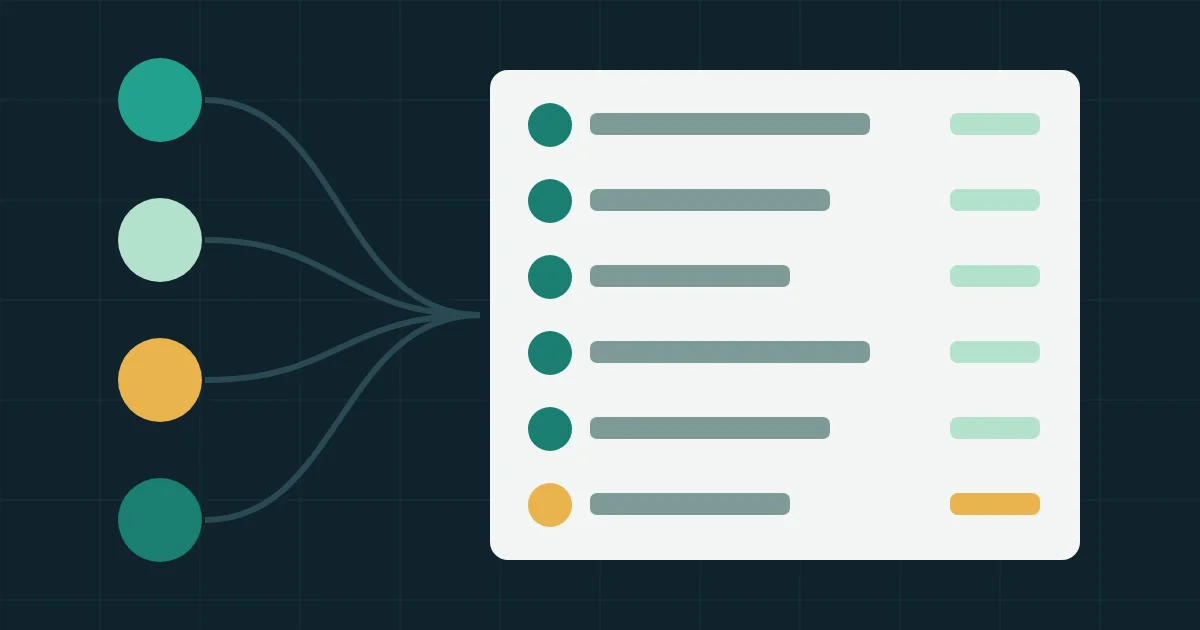
A lead follow-up system has six parts: one place all leads reach, a named owner for each lead, a written reply time, a sequence of attempts with an end, a written reason for each closed lead, and a weekly review of the numbers. You can build it with a shared spreadsheet this week, and add software and automation when you need them.
Most leads are not lost to a lazy employee. They are lost because nobody decided who replies, when to stop and what to write. Here you get the six parts, a responsibility table, a ready sequence, message samples, and what WhatsApp's rules allow.
Part one: one place for every lead
Start by listing every way a lead reaches you, then make them all end in one list. At most companies, leads nobody sees sit in these places:
- The site form and the inbox it goes to.
- Facebook and Instagram lead forms, which stay inside the platform unless you connect or export them.
- Page messages, WhatsApp and comments.
- Calls to the company number and to employees' personal phones.
- Referrals that go straight to the manager.
A shared spreadsheet is enough at first if leads are few. Once you fail the five-question test in when your company needs a CRM, it is time to move to a system.
Parts two and three: an owner for each lead and a written reply time
Each lead gets the name of one person. A lead that belongs to everyone belongs to no one. Decide how leads are assigned, by rotation, service or area, and who takes over when the owner is away.
Then write down the reply time. Harvard Business Review published research in 2011 on online leads and found that most companies do not respond fast enough. You can measure this easily: review your last 30 leads and work out the time between arrival and first reply.
No single number suits everyone, and what matters is choosing one you will keep. You could start with one working hour for new leads, and answer out-of-hours leads in the first hour of the next day, with an automatic message saying when you will reply. That is a practical suggestion to adjust for your team's size.
The responsibility table
| Task | Owner | Time | If it runs late |
|---|---|---|---|
| Recording the lead | Automatic or the sales coordinator | Immediately | The coordinator checks channels twice a day |
| Assigning the lead | Sales coordinator | Within 15 minutes | The sales manager takes it |
| First contact | Salesperson | Within one hour | An alert goes to the manager |
| Setting the next step | Salesperson | After each contact | The lead appears on the overdue list |
| Closing and its reason | Salesperson | When the sequence ends | The manager reviews it weekly |
| Reviewing the numbers | Sales manager | Weekly | Escalates to the owner |
On a small team one person may hold several rows. That is fine, as long as the times are written and everyone knows who covers absences.
Part four: a sequence of attempts with a clear end
Stopping after one attempt loses many leads, and endless chasing annoys customers and wastes your team's time. Copy this sequence and adjust it to your sales cycle. It is a practical suggestion and not a measured figure:
| Day | Channel | Purpose |
|---|---|---|
| Day of the lead | A call, then WhatsApp if no answer | Confirm the request and ask about the need |
| Day 2 | A call at a different time | Reach them if mornings are busy |
| Day 4 | A message with something useful about their request | Give value instead of a reminder |
| Day 7 | A last call | Offer a specific time |
| Day 10 | A polite closing message | Leave the door open and end the sequence |
Message samples to adapt
After an unanswered call: "Hello Mr. Ahmed, this is Sara from [company]. We received your request about [service] and I tried calling you. When would suit you for a five-minute talk, today or tomorrow?"
A useful message: "Mr. Ahmed, many customers ask about [the point relevant to this request]. Here is an explanation: [link]. If you like, we can go through it in a short call."
A closing message: "Mr. Ahmed, we have tried to reach you a few times and will not trouble you further. If this becomes a priority again, just reply here and we will pick up where we stopped."
The names are examples. Do not add false pressure such as "last chance" unless the offer's deadline is real.
What WhatsApp Business rules allow
If you use the WhatsApp Business Platform (API) and not the regular app, these rules directly affect your sequence. We reviewed them in November 2026, and they may change:
- Opt-in: WhatsApp's policy requires a person's opt-in before you message them, and you are responsible for how you obtain it. State on your request form that you will contact them on WhatsApp.
- The 24-hour window: When a customer messages you, a 24-hour customer service window opens in which you can send free-form messages. Outside it, you can send approved templates only.
- Blocks and opt-outs: You must respect a person's request not to be contacted and remove them from your contact list.
Customer data is also personal data, so review the Saudi law or Egypt's law on protecting it with your adviser. This section is not legal advice.
Parts five and six: a reason for each closure and a weekly review
Add a closing reason field with set options you can count later: price, chose a competitor, wrong time, outside our service, no answer, or not serious. This field turns follow-up from daily work into information marketing can use. If half your closures say "outside our service", the problem is ad targeting and not the salesperson. Our article on why you get plenty of leads and few sales helps you read that diagnosis.
Then review only these five numbers each week:
| Number | What it tells you |
|---|---|
| Leads by source | Which channel is working this week |
| Average time to first reply | If you keep to what you wrote |
| Share reached | Number quality and call timing |
| Leads with no next step | The number that should be zero |
| Top two closing reasons | What to fix in the offer or targeting |
Your next step
Review your last 30 leads today and count how many got no reply and how many stopped after one attempt. Then write the responsibility table with your team and run one sequence for a month. Once it settles, add the reminders and automatic messages covered in where to start with business process automation. The value becomes clearer when you tie it to your channels in where to start with digital marketing. If you want someone to build this system and connect it to your site and ads, take a look at PlanKit's business automation service.